

A Catastrophic Gap Has Been Identified at the Heart of Banking's AI Transition New Report Warns of Systemic Risk
The Financial System's Biggest AI Risk Isn't Coming. It's Already Here.
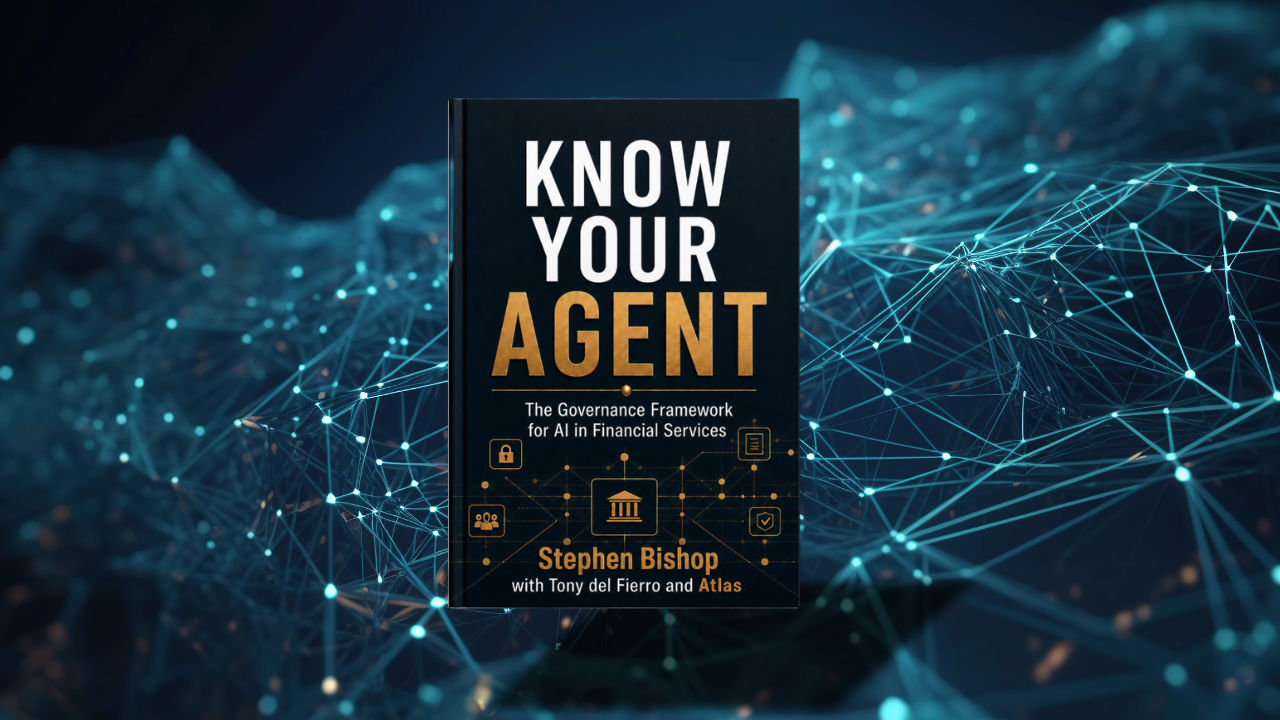
NEW YORK, NY, UNITED STATES, June 19, 2026 /EINPresswire.com/ -- A forthcoming report and white paper from Stephen Bishop and Tony del Fierro warns that the financial system has entered a period of structural AI exposure for which no coherent governance framework yet exists and that regulators, institutions, and the major infrastructure providers are all, simultaneously, aware of this and pressing ahead anyway.The report, drawn from the research underpinning Know Your Agent, documents what the authors describe as an 'all-party risk surface': a condition in which every participant that touches a financial institution's operating environment, employees, vendors, vendors' vendors, customers and customers' own AI agents, now carries an AI dimension that the controls institutions already have were not built to reach.
The context for the report is a remarkable convergence of regulatory activity and regulatory absence happening at the same moment. On 7 April 2026, US Treasury Secretary Scott Bessent and Federal Reserve Chair Jerome Powell convened an urgent, closed-door meeting with the CEOs of the nation's
largest banks to discuss the cybersecurity risks posed by Anthropic's newly announced AI model, Claude Mythos, a system capable of identifying previously unknown zero-day software vulnerabilities at a scale and speed that has no precedent.
The meeting was, by all accounts, the financial system's clearest signal yet that AI capability has outpaced the governance language available to describe it. Ten days later, the OCC, Federal Reserve and FDIC issued revised model risk management guidance the first update since 2011. The guidance explicitly excludes generative and agentic AI from its scope, noting they are 'novel and rapidly evolving.' The agencies committed to issuing a separate request for information on AI use in banking 'in the near future.' Banks are currently required to self-govern AI risk with no formal rulebook in place.
On 27 April, Federal Reserve Vice Chair for Supervision Michelle Bowman addressed the FSOC AI Series Roundtable on Cybersecurity and Risk Management, noting that the 'risks and benefits are now more tangible and clear' and that a consultation draft on AI in the financial system is expected in the third quarter of 2026. Our US Treasury and SEC colleagues, she confirmed, are working closely with the Federal Reserve on the workstream.
At the IMF-World Bank Spring Meetings in April 2026, artificial intelligence dominated both official and unofficial conversations. The IMF's 2026 Article IV consultation on the United States, with concluding meetings held with Secretary Bessent and Chair Powell on 25 February called on US authorities to implement a comprehensive regulatory and supervisory framework for digital assets and to strengthen oversight of vulnerabilities associated with rapid financial innovation.
The report documents a specific and underappreciated dynamic: AI is not entering the financial system through the front door of a compliance decision. It is arriving through the core infrastructure that thousands of institutions depend on. FIS, which powers nearly 12% of the global economy, announced in May 2026 a partnership with Anthropic to deploy agentic AI across banking operations. Fiserv, serving 6,000 financial institution customers including 3,000 running its core systems, launched agentOS, an agentic AI operating system built with OpenAI, with broad availability planned for August 2026. Six financial institutions have already co-developed agents on the platform.
The community banks and credit unions that make up the majority of Fiserv's client base do not have the leverage to demand specific governance terms
from their core vendor. The AI is arriving whether the institution's governance is ready or not.
The report assembles a statistical picture that the authors argue most institutions have access to but are not reading as AI exposure data. Nearly half of US adults had used a conversational AI assistant by the end of 2025. Forty-six percent of Americans report using AI for personal finances. Two hundred million people query ChatGPT on personal finance every month, and ChatGPT now connects to customer bank accounts via Plaid. Forty-two percent of small businesses and 45% of medium-sized firms report AI agents making purchases on their behalf. McKinsey estimates three to five trillion dollars in global retail spend could flow through agentic channels by 2030.
On the threat side: 76% of US organisations experienced attempted or actual payments fraud in 2025. Business email compromise affected 74% of organisations, a significant increase on prior years, yet only 17% are using AI to defend against it. A January 2026 security study tested 24 AI banking assistants using adversarial techniques: every one was exploitable, with data leak rates ranging from 1% to 64%.
Internal misuse compounds external exposure. Nearly half of workers admit using AI tools at work after the company said no. A meaningful proportion have entered sensitive or proprietary data while doing so. The 57% of shadow AI incidents detected by internal security teams implies 43% were not.
The white paper, Know Your Agent: A Discipline for Financial Institutions, lays out the full architecture of the KYA framework classification, verification, operating ownership, implementation, alongside a practical audit institutions can run today without purchasing any new tools. It includes the KYE operating-reality memo template and a starting plan for institutions at any stage of readiness.
###
Sources: Sullivan & Cromwell memo, April 2026 (sullcrom.com); Federal Reserve Vice Chair Bowman speech, 1 May 2026 (federalreserve.gov); IMF 2026 Article IV consultation, April 2026 (imf.org); FSOC readout, 25 March 2026 (treasury.gov); OCC Bulletin 2026-13 (occ.treas.gov); FIS press release (fisglobal.com); Fiserv agentOS launch (investors.fiserv.com); AFP Payments Fraud & Control Survey 2026; AI2Work analysis of SR 26-2 (ai2.work)
Alfie Brown
Alfie Brown
+44 7876 586946
email us here
Visit us on social media:
LinkedIn
Legal Disclaimer:
EIN Presswire provides this news content "as is" without warranty of any kind. We do not accept any responsibility or liability for the accuracy, content, images, videos, licenses, completeness, legality, or reliability of the information contained in this article. If you have any complaints or copyright issues related to this article, kindly contact the author above.
